Döziv Meaning: Why This Word Isn’t Real (And the Turkish Term It’s Probably Confused With
Search “döziv” and you’ll land on a cluster of articles that can’t agree on what it even is. Several describe it as a modern mindset about calm endurance and emotional balance during hardship. At least one defines it as foreign currency and exchange rates, tied to Turkish economics. Another claims it relates to “vibrant cuisine and cultural heritage.” A few openly admit it’s a coined, invented term with no real linguistic root at all. That level of contradiction is the clearest sign available that döziv isn’t an established word — it’s most likely a misspelling of a real Turkish word, döviz, that’s been reinterpreted into several unrelated, invented meanings by different content sources.
The Short Answer
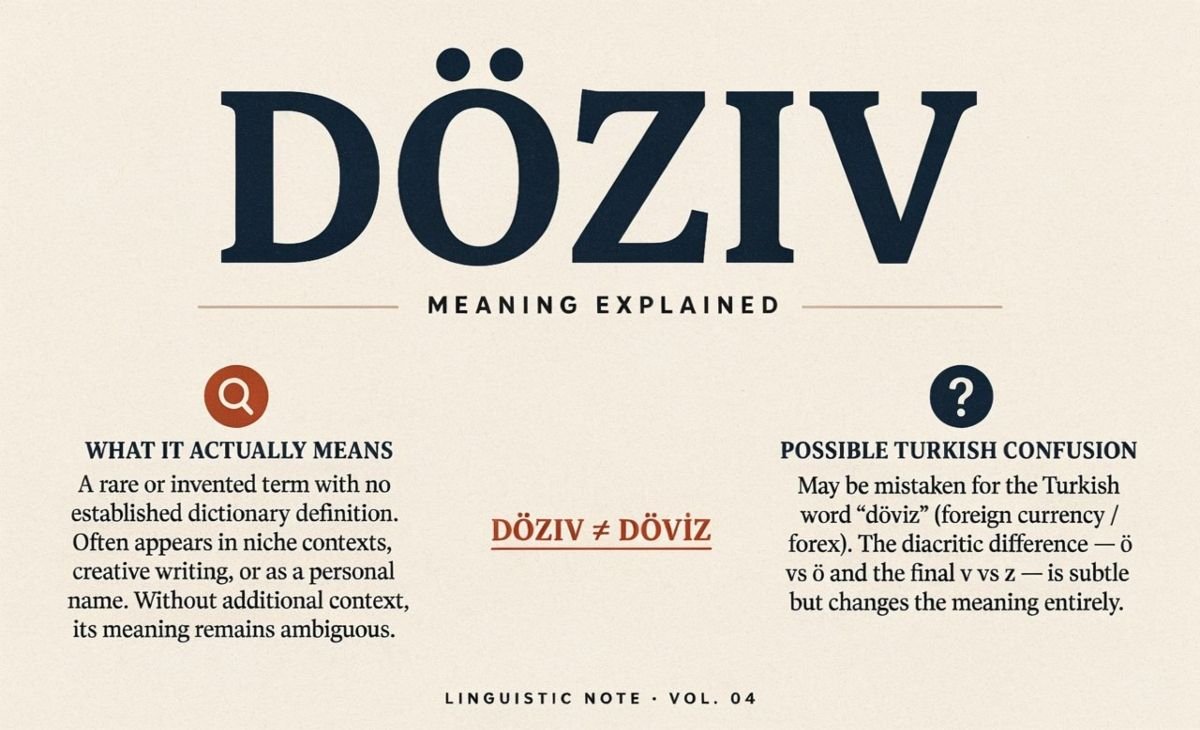
There’s no verifiable evidence that döziv is a genuine, documented word in any language. It doesn’t appear in standard dictionaries, and the content currently describing it gives mutually incompatible definitions — a resilience mindset, a term for foreign currency, and a reference to cuisine and culture, among others. The most likely explanation is that döziv is a misspelling or letter-scramble of döviz, the real, well-documented Turkish word for foreign currency and exchange rates.
What the Existing Articles Actually Claim
Looking across current coverage, the definitions genuinely don’t overlap:
- Several present döziv as an emerging personal-development concept about calm endurance, emotional balance, and purposeful thinking during hardship.
- One directly defines döziv as foreign currency, explaining how “döziv rates” affect inflation, import costs, and consumer prices in countries like Pakistan — describing it in purely financial terms with no mention of resilience or mindset at all.
- Another frames it as a “conceptual response to challenge,” distinct from both survival and traditional resilience.
- One result ties it to cuisine and cultural heritage, with no connection to either of the above.
- Several openly state that döziv has no confirmed etymological root in any language and appears to have “emerged organically online.”
A genuinely established word — even a rare or specialized one — doesn’t generate this kind of scattered, contradictory coverage. Sources describing a real term typically converge on a consistent meaning, even if their framing or examples differ.
The Real Word This Likely Comes From: Döviz
The most telling clue is a real, well-documented Turkish word sitting almost directly on top of döziv: döviz, meaning foreign currency or foreign exchange. It’s a standard term in Turkish banking, finance, and everyday economic discussion — you’ll see it on currency exchange counters, in news coverage of exchange rates, and in financial reporting throughout Turkey and other Turkish-speaking contexts.
Notably, at least one article already conflates döziv and döviz directly, describing “döziv” purely in terms of currency exchange rates and their effect on inflation and import prices — content that appears to be genuinely about döviz, simply spelled and labeled incorrectly throughout.
Döziv and döviz share every letter, just reordered — the kind of near-identical letter transposition that commonly turns a real, correctly spelled word into an accidental “new” term once it starts circulating online. From there, other content creators appear to have encountered the misspelling with no clear definition attached, and built their own unrelated explanations around it rather than tracing it back to the real Turkish word.
Why “Emotional Resilience Mindset” and “Foreign Currency” Can’t Both Be Right
This is the clearest sign that something has gone wrong in how this term is being covered. A genuine word can have multiple related senses (English “bank” can mean a financial institution or a riverbank), but those senses are still consistently documented and don’t change depending on which website you land on. Here, “döziv” is described as a psychological framework for enduring hardship on one set of sites and as a financial/economic term on another, with zero acknowledgment from either side that the other definition exists. That’s not multiple senses of one real word — it’s multiple, independent inventions built around an undocumented spelling.
You May Also like this: Çievri Meaning: Why This “Trending Word” Isn’t Real (And What It’s Actually a Misspelling Of)
Why Some Articles Openly Admit It’s Invented
To their credit, a few of the articles covering döziv are relatively upfront: they describe it as a “neologism,” a coined or created term with no confirmed root in any language, that “emerged organically in online environments” the way usernames or brand names sometimes do. This is more honest than claiming a false etymology outright. But it still doesn’t establish döziv as a real, meaningful term — it just relocates the claim from “this is an ancient concept” to “this is a new concept that people are now giving meaning to,” which is a much lower bar and doesn’t require any of the elaborate psychological framework built around it in the same articles.
Why the Letter Ö Doesn’t Confirm a European Origin
Several articles point to the umlaut in “ö” as evidence of a “European” or “global” linguistic feel. It’s true that ö appears in several real languages, including Turkish, German, Swedish, and Finnish, each with specific pronunciation rules. But a distinctive letter on its own doesn’t establish a genuine word — it’s a stylistic signal, not linguistic proof. Real words from ö-using languages follow that language’s broader spelling and grammar conventions consistently, not just borrow a single visually interesting character.
How to Verify a Term Like This
The same checklist applies here as with any unfamiliar, foreign-looking word that shows up with a confident “meaning” article attached:
- Check a dedicated dictionary for the language the spelling suggests — for döziv, a Turkish dictionary would immediately clarify that döviz, not döziv, is the real, established term.
- Notice contradictory definitions across sources as a stronger red flag than simple stylistic variation. Genuine words don’t get defined as both a psychological mindset and a financial term with no acknowledgment of the discrepancy.
- Be skeptical of “neologism” framing used to sidestep verification. Calling a term an “emerging concept” or “digital-era coinage” can be accurate, but it’s also a convenient way to avoid the fact that no one can point to where or how it actually originated.
- Search the exact spelling alongside a specific language name to check for genuine, dated usage outside the explainer-article cluster itself.
Final Thoughts
Döziv doesn’t appear to be a genuine, established word in any language. The content currently covering it can’t agree on even a basic category for what it supposedly means — psychological mindset, financial term, or cultural reference — which is a strong sign that no shared, verified source actually exists behind any of these explanations. The most plausible explanation is that it’s a letter-scrambled misspelling of döviz, the real Turkish word for foreign currency, that different content sources have since built unrelated, invented meanings around. If you’re genuinely curious about the concept of calm endurance during hardship, that’s a real and worthwhile thing to explore — it just already has well-established names, like emotional regulation, mindfulness, or resilience, without needing an invented word attached to it.
FAQs About Döziv
Is döziv a real word?
There’s no verifiable evidence that it is. It doesn’t appear in standard dictionaries, and sources describing it give contradictory, unrelated definitions.
What is döziv probably a misspelling of?
The most likely candidate is döviz, a real, well-documented Turkish word meaning foreign currency or foreign exchange.
Why do some articles define döziv as a mindset and others as a currency term?
Because it isn’t a genuine, established word with one verified meaning. Different content sources appear to have built independent, unrelated explanations around an undocumented spelling.
Is döziv a coined or invented word?
Several sources describe it this way, framing it as a modern neologism with no confirmed root in any language. Even under this framing, though, it isn’t an established term with any agreed-upon meaning.
How can I check if an unusual word like this is real?
Search a dedicated dictionary for the language its spelling suggests, and treat inconsistent or contradictory definitions across sources as a strong sign of an unverified or fabricated term.