What Does “Laaster” Mean? The Truth About This Afrikaans/Dutch Term
If you’ve come across the word “laaster” online — maybe in a search, a forum post, or an article claiming to explain its deep cultural history — there’s something worth knowing upfront: “laaster” is not a standard, documented word in Dutch or Afrikaans. The real word is laster, spelled with a single “a,” and it has a well-established, verifiable meaning. This article explains what laster actually means, where the “laaster” spelling comes from, and why so much conflicting content about it exists online.
The Short Answer
“Laaster” is most likely a misspelling or informal variant of laster, a real Dutch and Afrikaans word meaning slander or defamation — harmful, false speech directed at someone to damage their reputation. The double “a” spelling does not appear as a recognized entry in standard Afrikaans or Dutch dictionaries. If you’re trying to understand the word’s real meaning, “laster” is the term to look up.
What “Laster” Actually Means
In both Dutch and Afrikaans, laster refers to slander: a false, damaging statement made about a person with the intent — or effect — of harming their reputation. The related verb, lasteren (Dutch) or laster (Afrikaans, used verbally), means “to slander” or “to speak falsely and harmfully about someone.”
This isn’t a niche or obscure term. It’s a standard dictionary word in both languages, used in everyday speech, legal contexts, and religious or moral discussions about honesty and reputation.
Where “Laster” Comes From
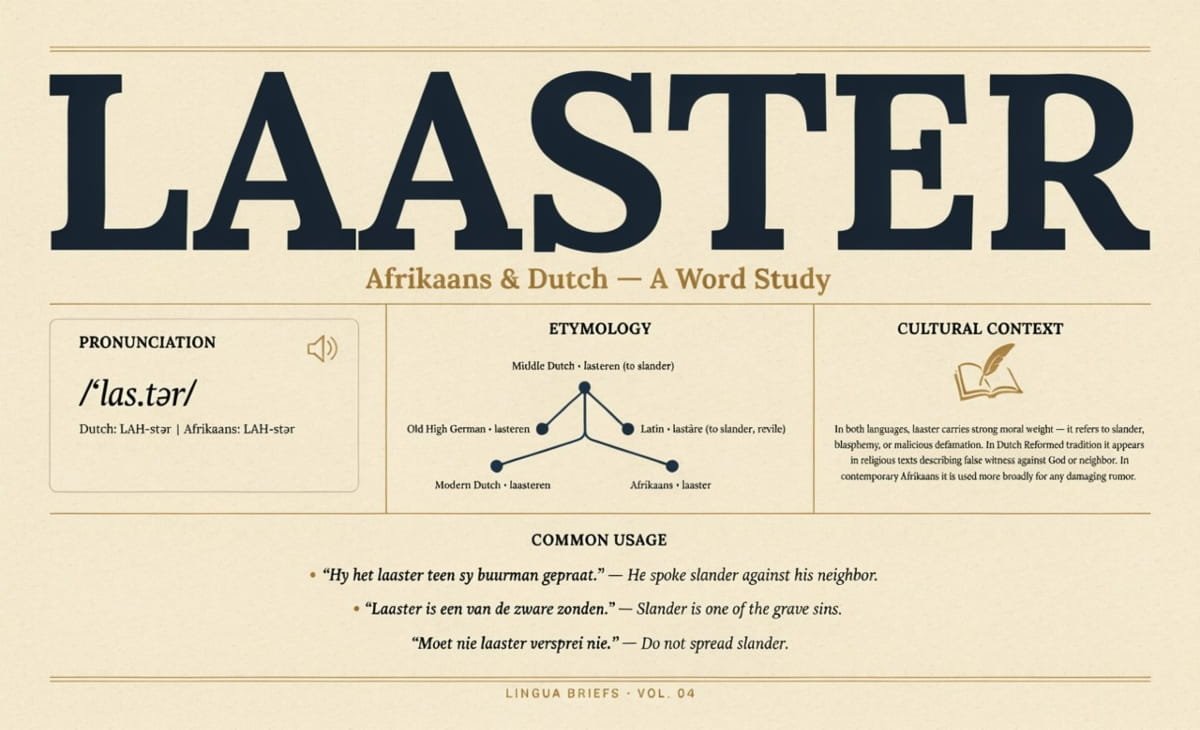
Laster traces back to the Middle Dutch verb lasteren, which carried a dual meaning: to defame a person, or to blaspheme against something sacred. That dual sense — harmful speech against either a person or a deity — reflects how seriously verbal harm was treated in medieval Dutch moral and religious life.
When Dutch settlers brought their language to southern Africa in the 17th and 18th centuries, Afrikaans developed as a distinct language but retained laster largely intact, along with its core meaning of slander or defamation.
German has a related, though not identical, word: Laster, meaning “vice” or “disgrace,” and lästern, meaning to speak disparagingly or mock. The shared Germanic root points to a common thread across these languages — words describing speech or behavior that violates social or moral norms.
Why “Laaster” Shows Up in Searches
The double-a spelling appears to have entered online circulation the way many misspellings do: through repeated typos, autocorrect variations, or informal writing that got picked up and treated as a legitimate alternate spelling rather than an error. Once a misspelling starts appearing in enough search queries, content gets written to target it — and that content often has to invent an explanation for the “variant,” since no real dictionary source supports it.
That’s a distinct issue from normal spelling variation. Real regional or dialectal differences (like British vs. American English spellings) are documented and consistent. “Laaster” doesn’t appear this way in Afrikaans language resources such as the HAT (Verklarende Handwoordeboek van die Afrikaanse Taal) or WAT (Woordeboek van die Afrikaanse Taal), the standard reference dictionaries for the language.
Why the Online Definitions of “Laaster” Contradict Each Other
If you search “laaster” right now, you’ll find articles that define it in wildly different ways: some describe it as an Afrikaans word for slander with centuries of religious and cultural weight; others describe it as a modern tech buzzword blending “latency” and “mastery”; others frame it as a meaningless, brandable word used for usernames and art projects with no fixed definition at all.
This kind of contradiction is a strong signal that a word isn’t actually established — genuine dictionary terms don’t generate five incompatible definitions from different sources. It’s a pattern typically seen when a misspelling or rare term gets picked up by multiple content creators who each fill the definitional gap with their own explanation, rather than working from a shared, verifiable source.
How Laster Is Used in Afrikaans Today
In Afrikaans-speaking communities — primarily in South Africa, Namibia, and parts of Zimbabwe and Botswana — laster remains part of everyday moral vocabulary. Being told “moenie laster nie” (“don’t slander”) carries real social weight, similar to being told not to lie.
This is partly rooted in the strong influence of Calvinist and Dutch Reformed religious traditions on Afrikaans culture, where harmful speech has long been treated as a moral, not just social, wrong. South African law also treats defamation (the legal concept laster describes) as a recognized civil wrong under common law, derived from Roman-Dutch legal tradition.
Laster vs. Gossip vs. Defamation
These terms are often used loosely and interchangeably, but they aren’t the same:
- Gossip is the casual sharing of information or rumors, which may or may not be true, and generally carries no legal weight.
- Laster (slander) specifically refers to a false, spoken statement made to damage someone’s reputation.
- Defamation is the broader legal category covering both spoken (slander) and written (libel) false statements that cause reputational harm.
Laster requires falsehood and harmful intent or effect. Harsh but truthful criticism — even public, pointed criticism — is not laster, since the statement isn’t false.
Final Thoughts
“Laaster” isn’t a documented word in Dutch or Afrikaans — it’s best understood as a misspelling of laster, a real and long-established term meaning slander or defamation. The word’s actual history is genuinely interesting: it traces back to Middle Dutch, carries religious as well as social weight in Afrikaans culture, and remains in active everyday use today. If you encountered “laaster” and wanted to understand what it means, laster is the word — and the history — worth knowing.
FAQs About Laster and Laaster
Is “laaster” a real word?
Not in standard Dutch or Afrikaans dictionaries. It appears to be a misspelling or informal variant of laster, the correctly spelled and well-documented word.
What does laster mean?
Laster means slander or defamation — a false, harmful statement made about someone with intent, or effect, to damage their reputation.
What language is laster from? Laster comes from Dutch, tracing back to the Middle Dutch verb lasteren. Afrikaans, which developed from Dutch, retained the word with its meaning largely intact.
Is laster the same as gossip?
No. Gossip may be truthful and low-stakes. Laster specifically involves false statements made with harmful intent.
Is laster a legal term?
The concept it describes — defamation — is a recognized legal term, particularly in South African common law. Laster itself is more commonly used in everyday speech than in formal legal documents.
Why do so many websites define “laaster” differently?
Because it isn’t an established dictionary word, different content creators have filled the definitional gap with their own explanations — resulting in inconsistent, sometimes contradictory claims across search results.